My ClassicPress Website

Lebanon Casualty Surge Tyre Airstrike Hezbollah Missile Salvo Escalation
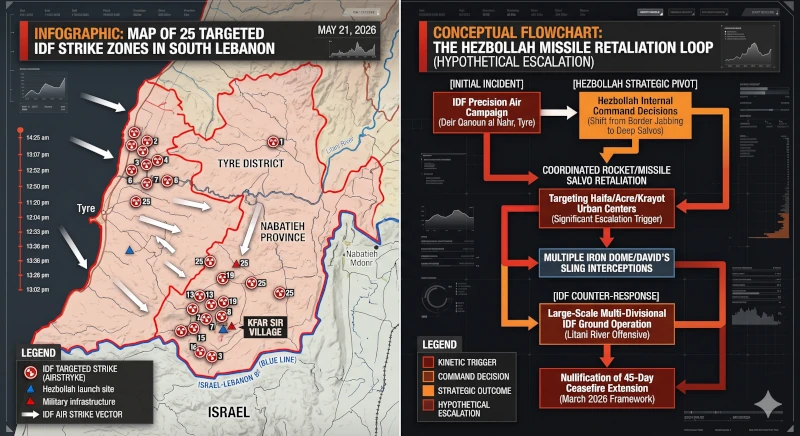
[THE LEBANON ESCALATION LOOP]

┌─────────────────────────────────────────────────┐
▼ │
[IDF Precision Air Campaign] │
(Destroys 25+ Nodes, High Casualties) │
│ │
▼ │
[Hezbollah Strategic Pivot] │
(Shifts from Tactical Border Jabbing to Deep Salvos) │
│ │
▼ │
[Large-Scale Missile Salvo on Israel] │
(Targets Haifa/Acre/Krayot Urban Centers) │
│ │
└─────────────────────────► [IDF Multi-Division Ground Push]
(Nullifies 45-Day Ceasefire Extension)

WarsWW Spotlight: The “Tattered” Truce & Israeli Escalation Tempo in Lebanon [REF: LEB-ESC-2026]

Despite the recent 45-day extension of the U.S.-brokered ceasefire on May 15, the northern front has entered its most precarious kinetic window since the March resumption of full-scale hostitilities. A devastating series of Israeli airstrikes has shattered local calm, shifting the battlefield focus from defensive positioning to an imminent threat of massive cross-border retaliation.

I. The 24-Hour Casualty Surge

The Israel Defense Forces (IDF) have radically compressed their strike timeline, executing a high-tempo air campaign across southern and central Lebanon.

  • The Deir Qanoun al Nahr Strike: The deadliest single event occurred in the coastal Tyre province, where a localized Israeli strike completely leveled a residential building, killing 10 people—including three women and three children. Civil defense crews are still manually clearing rubble to extract remains.
  • Deep Sector Interdiction: Simultaneous strikes targeted Nabatieh and the nearby village of Kfar Sir, bringing the immediate 24-hour death toll to 19 confirmed dead and scores more wounded.
  • The IDF Justification: The military confirmed it struck more than 25 high-value Hezbollah infrastructure sites in a 24-hour block, claiming that the targeted nodes were actively preparing or hosting launch systems for explosive attack drones.

II. Tactical Indicators: Tracking the Impending Missile Salvo

The current escalation loop mirrors the highly volatile patterns tracked earlier this spring, specifically following the targeting of the Radwan Force command tier in Dahieh.

  • The Threshold of Retaliation: Historically, when single-day civilian casualties from Israeli airstrikes exceed 15 in the southern sectors, Hezbollah alters its tactical restraint rules. Intelligence nodes are currently tracking high-probability telemetry indicating that the group is preparing a wide-area response.
  • The Target Profile: Since the April 17 truce framework, Hezbollah has largely focused its high-volume drone and rocket assets directly on IDF ground units inside southern Lebanese buffer zones (accounting for over 82% of its 220 recent attack waves).
  • The Escalation Trigger: A deep-strike missile salvo targeting the Krayot area, Haifa, or communities adjacent to civilian concentrations would break the unwritten operational boundaries of the extension. A coordinated rocket response of this magnitude would likely trigger an immediate, multi-divisional IDF ground counter-push deeper toward the Litani River.

III. The Strategic Fallout

The timing of this kinetic surge exposes the complete fragility of broader regional mediation. While the international community attempts to resolve the maritime crisis in Iran, the 2026 Lebanon War functions as an independent powder keg. With cumulative conflict deaths in Lebanon now firmly surpassing 3,000, both command structures are operating on hair-trigger alert.

WarsWW Intelligence Note [REF: DAILY-2026-0521-SPOT]

Do not look at the 19 dead in Tyre as an isolated incident. It represents the upper limit of what the current ceasefire extension can absorb. If Hezbollah initiates a multi-layered missile wave over the border to avenge Deir Qanoun al Nahr, the diplomatic infrastructure built by Western envoys will collapse instantly, pulling Israel into a deeper multi-front air and ground campaign.

PGSA Strait Of Hormuz Permit Toll | Refinery Drone Strike May 21 2026
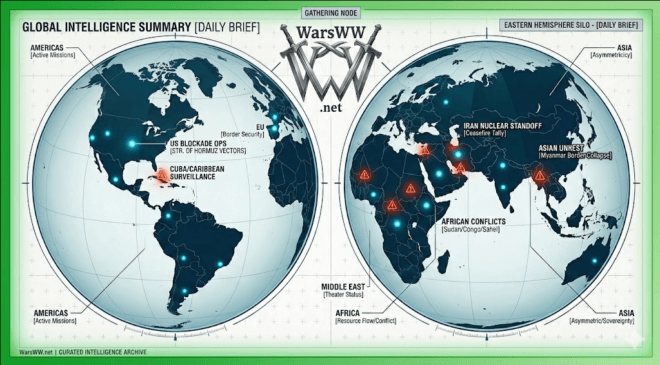
WarsWW Daily Brief | May 21, 2026

Intelligence Status: SOVEREIGN WATERWAY ENFORCEMENT / PETROLEUM INTERDICTION

Global Security Index: 9.8/10 (Severe Market Friction)

I. Middle East: Iran Institutionalizes the Hormuz “Permit & Toll” Regime

The standoff in the West Asia conflict has advanced from tactical military skirmishes to an aggressive legal and bureaucratic annex of global trade. Following weeks of maritime disruptions since the outbreak of hostilities in February, Tehran has operationalized a new mechanism to permanently sovereignize international transit passage through the Strait of Hormuz.

  • The PGSA Electronic Net: The newly minted Persian Gulf Strait Authority (PGSA) has officially drawn its geographic boundaries of enforcement. The zone functions as a strict maritime checkpoint bounded by a line connecting Kuh-e Mobarak (Iran) to southern Fujairah (UAE) on the eastern side, stretching to the tip of Qeshm Island (Iran) and Umm Al-Quwain (UAE) on the western threshold.
  • The Permit Mandate: All commercial shipping intending to cross the chokepoint must now coordinate directly with and secure digital authorization from the PGSA before tracking into the strait. Maritime intelligence firms note this effectively converts a historically open transit corridor into a state-administered permit and toll regime.
  • Kinetic Enforcement: The Islamic Revolutionary Guard Corps (IRGC) Navy is actively backing this regulatory push from Qeshm Island. The IRGC reiterated that warships are completely barred from passage and defended prior kinetic targeting of non-compliant vessels, asserting that refusal to obtain permits violates sovereign governance.
  • The US Counter-Blockade: The Trump administration is pushing back aggressively to force the waterway open. The US military boarded an Iranian-flagged oil tanker in the Gulf of Oman suspected of violating the American naval blockade. Simultaneously, Pakistan’s Army Chief Asim Munir has arrived in Tehran to mediate high-stakes peace proposals as Trump warns that negotiations are sitting on the borderline between a structural breakthrough and renewed military action.

II. Eastern Europe: The Syzran Refinery Strike

Ukraine’s strategic air campaign against the Russian energy ecosystem reached deeper into the domestic rear overnight, executing a highly accurate long-range drone operation.

  • The 800-Kilometer Incursion: Ukrainian long-range kamikaze drones bypassed extensive electronic warfare frameworks to target the Syzran Oil Refinery in the southern Samara region, more than 800 kilometers (500 miles) deep inside Russian territory.
  • Operational Impact: President Volodymyr Zelenskyy confirmed the attack, which ignited major fires across the Rosneft-operated facility. Local authorities acknowledged that two people were killed in Syzran during the raid. The strike severely degrades Russia’s capacity to process crude into military-grade fuel, following previous drone actions that have forced multiple central refineries to cut or entirely halt production.
  • The Air Attrition War: Russia’s Defense Ministry claimed its defensive grids intercepted a staggering 121 Ukrainian drones across the country. Conversely, Moscow launched its own wave of 116 drones into Ukrainian civilian and energy hubs, with Ukraine’s tactical air defense systems successfully downing 109 of the incoming targets.

III. Indicators to Watch

  • [LOGISTICS] Tanker Compliance Matrix: Watch the insurance telemetry of global shipping conglomerates over the next 48 hours. If European or Asian tankers begin complying with the email-based PGSA permit mandates, it will signal a de facto recognition of Iran’s regulatory control over the chokepoint.
  • [DIPLOMACY] The Enriched Uranium Redline: Monitor the outcome of Pakistan’s mediation track in Tehran. Hardline factions within Iran are pushing to keep highly enriched uranium inside the country, directly defying a core American prerequisite for lifting the naval blockade.

WarsWW Intelligence Note [REF: DAILY-2026-0521]

The creation of the PGSA is a masterclass in asymmetrical lawfare. By utilizing a nominal regulatory entity to dictate maritime coordinates between Iran and the UAE, Tehran is attempting to force commercial fleets to pay for protection, turning an active combat zone into a bureaucratic customs barrier. Meanwhile, Ukraine’s successful penetration into Samara proves that Russia’s massive electronic warfare investment cannot perfectly insulate its economic lifeblood from persistent, low-RCS drone swarms.
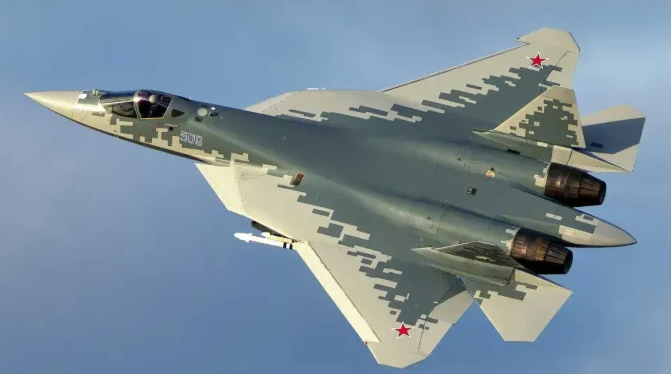
WarsWW Spotlight: The Su-57D “Felon” Twin-Seat Drone Buster

WarsWW Spotlight: The Su-57D “Felon” Twin-Seat Drone Buster [REF: VKS-SU57D-2026]

The Russian Aerospace Forces (VKS) have officially introduced a radical paradigm shift in fifth-generation aviation. On May 19, 2026, the Sukhoi Su-57D “Felon” completed its highly anticipated maiden flight, transitioning the platform from a standalone stealth fighter into a dedicated airborne battle management hub designed specifically to counter and control unmanned systems.

[SU-57D “FELON” COCKPIT ARCHITECTURE]
┌────────────────────────────────────────────────────────┐
│ [Pilot – Front Seat] │ [Mission Commander – Rear]│
├───────────────────────────┼────────────────────────────┤
│ – Flight Controls │ – MUM-T AI Drone Link │
│ – 360° Radar Monitoring │ – EW Interception Node │
│ – Supersonic Supercruise │ – “Okhotnik” FPV Guidance │
└───────────────────────────┴────────────────────────────┘

I. The Tandem Architecture: Why Two Seats Matter

The most striking feature of the newly unveiled Su-57D variant is its elongated tandem cockpit canopy, making it only the second fifth-generation stealth fighter in the world to adopt a two-seat configuration after China’s Chengdu J-20S.

II. Technical Specifications & Combat Roles

The United Aircraft Corporation (UAC) has built the Su-57D to act as an Apex Predator over contested airspace, though the addition of a second seat forces distinct design tradeoffs.

III. Urgent Context: Industrial Scramble After Shagol Airbase

The rollout of the Su-57D comes at a moment of acute vulnerability for Russia’s stealth program. Just weeks ago, on April 25, 2026, Ukraine’s Unmanned Systems Forces executed a devastating 1,700 km deep-rear kamikaze drone strike on the Shagol Airfield in Chelyabinsk, where several baseline Su-57s were parked.

WarsWW Intelligence Note [REF: SU57D-AERIAL-0520]

The Su-57D “Felon” is the Kremlin’s direct technological answer to its current air defense vulnerabilities. Unable to stop low-altitude Ukrainian drone swarms with ground-based S-400 batteries alone, Moscow is shifting the fight to the sky. By placing a flying drone command post at Mach 2, the VKS hopes to use the Su-57D to intercept incoming UAVs at long range before they can threaten critical mainland targets again.

image from: https://www.flyajetfighter.com

Ukraine Middle Strikes | Moscow Refinery | May 20, 2026

WarsWW Daily Brief | May 20, 2026

Intelligence Status: RE-ROUTED LOGISTICS / OPERATIONAL DEPTH INTERDICTION

Global Security Index: 9.8/10 (Severe Market Rupture)

I. Eastern Europe: The “Decisive” Pivot to Middle-Range Strikes

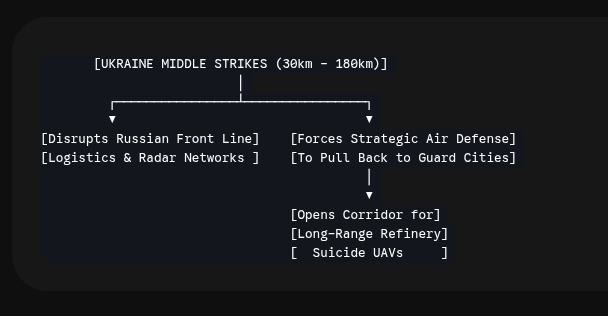
The nature of the Ukraine-Russia air war has structurally shifted. According to battlefield commanders, Ukraine has vastly scaled up and quadrupled its “middle-strike” capabilities since February, focusing on targets 30km to 180km behind frontlines to bleed Russian logistics at operational depth.

       [UKRAINE MIDDLE STRIKES (30km - 180km)]
                          │
         ┌────────────────┴────────────────┐
         ▼                                 ▼
[Disrupts Russian Front Line]    [Forces Strategic Air Defense]
[Logistics & Radar Networks ]    [To Pull Back to Guard Cities]
                                           │
                                           ▼
                                 [Opens Corridor for]
                                 [Long-Range Refinery]
                                 [  Suicide UAVs     ]

II. Global Economics: The Trade-Off of the Hormuz Blockade

The U.S.-Israeli kinetic escalation against Iran has triggered a cascading crisis in Western economic policy, forcing a quiet re-evaluation of current secondary sanctions.

III. Kremlin Attrition: Personnel and Tactical Realities

IV. Indicators to Watch

WarsWW Intelligence Note [REF: DAILY-2026-0520]

The global geopolitical theater is experiencing an ironic inversion. Ukraine’s specialized “middle strikes” are successfully choking off Russian oil refining infrastructure at home, yet the simultaneous conflict in Iran has forced Ukraine’s closest Western allies to turn a blind eye to third-party Russian oil imports just to stabilize their own domestic energy grids.

Daily Brief May 19, 2026

The dominant story of the past 24 hours is the Iran war crisis entering a fragile de-escalation phase, with Trump claiming he called off an imminent bombing campaign at the request of Gulf allies, while Iran reportedly signals willingness to negotiate a nuclear deal before hostilities resume. Simultaneously, a suspected hate crime shooting at a San Diego mosque killed three, underscoring domestic tension during a period of heightened Middle East conflict. Markets reflect deep anxiety: equities are down sharply across all indices with the Fear & Greed Index deep in “Extreme Fear” territory at 25.

KEY DEVELOPMENTS

INDICATORS TO WATCH (Next 24–48 Hours)

  1. Iran nuclear negotiations: Watch for any formal channel opening — whether via Oman, Pakistan, or Gulf intermediaries — confirming Trump’s pause is real vs. tactical messaging. Any breakdown resumes imminent strike risk for Gulf energy markets.
  2. Barakah Nuclear Plant damage assessment: UAE and IAEA statements on the extent of the reported drone strike. If the strike penetrated cooling or reactor infrastructure, this becomes a Category 1 nuclear safety and Gulf security escalation.
  3. U.S.-Canada defense suspension fallout: Congressional reaction and NATO ally responses. Watch for Canada to signal alternative security arrangements (e.g., bilateral UK-Canada or EU security dialogue).
  4. DRC/Uganda Ebola PHEIC response: WHO Emergency Committee actions, international health resource mobilization, and whether Uganda confirms cross-border spread requiring elevated containment protocols.
  5. VP Vance White House press briefing (19 May, 13:00 ET): First direct public statement on Iran de-escalation posture, Canada defense suspension, and domestic hate crime response. Could move markets and clarify policy ambiguity.

Estonia Intelligence Russia Military Limits Ukraine Internet Crackdown Backlash 2026

WarsWW Intelligence Note: The “Cracked” Kremlin [REF: EST-INT-2026]

ESTONIA INTEL: NO RUSSIAN ATTACK ON NATO EXPECTED IN 2026; KREMLIN FACES BACKLASH OVER INTERNET BANS; RUSSIAN MILITARY COMMUNICATION DEGRADES AFTER STARLINK CUTOFF.

As the full-scale invasion of Ukraine enters its fifth year, a landmark assessment from Northern Europe suggests that the Kremlin’s expansionist reach has hit a physical and domestic limit. The Estonian Foreign Intelligence Service (EFIS) concludes that Russia currently has no intention of militarily attacking Estonia or any other NATO member in 2026, as its military remains fully occupied in its pursuit of Ukraine’s complete subjugation.

I. The Exhaustion of the “Soviet Inheritance”

The primary constraint on Russian aggression elsewhere is the sheer scale of its losses in the Ukrainian theater.

II. Internal Pressure: The Starlink Breakdown & Communications Collapse

The Kremlin is grappling with brewing internal military pressure following a series of battlefield failures in April and May 2026.

III. Domestic Friction: Crackdowns, Taxes, and Inflation

Beyond the battlefield, the Russian state is facing a “sovereignization” crisis that is alienating its own populace.


WarsWW Intelligence Note [REF: RU-LIMITS-2026]

The Kremlin is trapped in a period of sustained confrontation that it can no longer afford to expand. While Russia remains a long-term threat to European security, the “omnipresent hand” of the Kremlin is being slowed by the weight of its own failures. For now, the “Special Path” has become a road of domestic and military attrition.


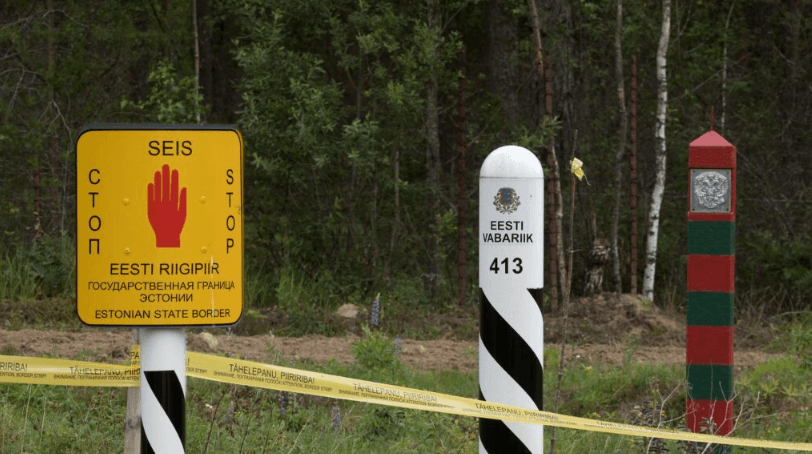
image from https://estonianworld.com/

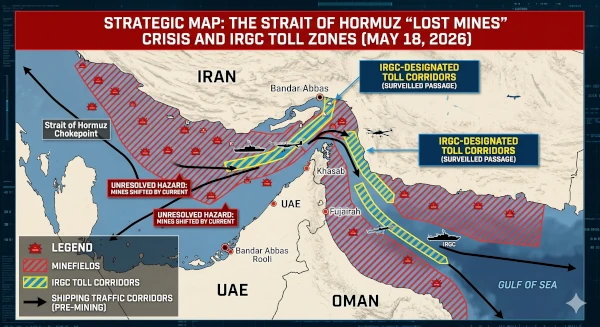
Iran Lost Naval Mines Strait Of Hormuz IRGC Toll Crisis 2026

WarsWW Spotlight: The “Lost Mines” of the IRGC [REF: IRN-HORMUZ-2026]

IRAN ADMITS ‘TECHNICAL LIMITATIONS’ IN LOCATING HORMUZ MINES; IRGC PROPOSES $2M TOLL FOR SAFE PASSAGE; US NAVY MCM ASSETS REMAIN DISTANT.

A growing intelligence crisis in the Middle East has revealed that the Islamic Revolutionary Guard Corps (IRGC) has effectively lost control of its own primary deterrent. Recent reports from senior U.S. officials indicate that Iran is unable to fully reopen the Strait of Hormuz because its naval crews cannot locate the thousands of sea mines they chaoitically deployed during the March 2026 escalation.

I. Haphazard Mining and the “Command Gap”

The crisis stems from the decentralized nature of the Iranian mining operation. Intelligence suggests the IRGC utilized small, fast attack boats to “haphazardly” seed the waterway with an estimated 2,000 to 6,000 mines.

II. The “Extortion Corridor” and Technical Paralyzation

Struggling to manage the hazard, Iran has attempted to pivot the crisis into a revenue stream while acknowledging its “technical limitations.”

III. Strategic Fallout: A Permanent Threat to UNCLOS

Maritime experts warn that the weaponization of uncertainty in Hormuz represents a frontal assault on the “transit passage” regime established by the UN Convention on the Law of the Sea.


WarsWW Intelligence Note [REF: HORMUZ-MINE-0518]

The IRGC has accidentally achieved a “perfect blockade.” By losing track of their assets, they have created a permanent, self-sustaining hazard that keeps global energy markets hostage regardless of diplomatic progress. The reopening of the Strait of Hormuz is no longer just a matter of political will; it is now an industrial-scale demining operation that could take months, if not years, to complete.


Daily Brief Ukraine Drone Swarm | Sudan Drones May 18 2026

WarsWW Daily Brief | May 18, 2026

Intelligence Status: ESCALATED AERIAL ATTRITION / THE DRONE OVERWATCH

Global Security Index: 9.7/10 (Critical Friction)

KYIV DARNYTSKYI DEATH TOLL STANDS AT 24; IRAN FORMS HORMUZ MARITIME AUTHORITY (PGSA); HEZBOLLAH FPV DRONE HITS IRON DOME; UN WARNS OF SUDAN DRONE CASUALTIES.

I. Eastern Europe: The “Deep Reach” Attrition Campaign

A massive escalation in aerial warfare has turned the region into a high-stakes duel over industrial and civilian infrastructure.

II. Middle East: The “Tattered” Truce & Hormuz Oversight

Drones are now being utilized both to bypass and enforce unstable ceasefires across the Middle East.

III. Africa: Sudan’s “Invisible” Drone War

The UN has issued a dire warning: Armed drones have become the leading cause of civilian deaths in Sudan’s conflict.

IV. Indo-Pacific: Pag-asa (Thitu) Sentinel Status

The Philippines has reached a critical milestone in its “deterrence by presence” strategy.


V. Spotlight: The Prague Armored Vehicle Summit

The 12th Annual Future Armoured Vehicles Central and Eastern Europe Conference opened today in Prague, bringing together three Major Generals and five Brigadier Generals from multiple NATO commands.


WarsWW Intelligence Note [REF: DAILY-2026-0518]

The common thread today is “Drone Saturation.” From the 500+ UAV swarm in Ukraine to the Iranian oversight authority in Hormuz, air superiority is no longer about expensive jets—it’s about who can maintain the most persistent, low-cost “eye in the sky” and who can jam it first.


Nakba 78th Anniversary Protests Europe Paris Athens Stockholm

Feature: 78 Years of “The Catastrophe” | Global Nakba Commemorations

While the official anniversary falls on May 15, tens of thousands of demonstrators have flooded the streets of major European capitals throughout the weekend of May 16–17, 2026. These rallies are no longer just historical remembrances; they have evolved into a coordinated global denunciation of current kinetic operations in Gaza and the West Bank aa.com.tr.

I. The European Convergence

Coordinated marches across Europe have highlighted a unified front against what protesters describe as “continued dispossession” aps.dz.

II. The “Catastrophe” at 78: Displacement Metrics

For the WarsWW archive, the 78th anniversary is marked by a return to 1948-level displacement statistics aljazeera.com.

III. Indicator: The “Right of Return” vs. Geopolitical Reality

The 2026 protests have been characterized by a harder line on the “Right of Return.” University-based groups across Europe and North America have spearheaded these demonstrations, using occupations and sit-ins to keep the Nakba at the forefront of the international security dialogue solaceglobal.com.


WarsWW Intelligence Note [REF: FEATURE-2026-0517]

The scale of the 78th anniversary protests suggests that the “Palestinian Question” has moved from a regional dispute to a pillar of European domestic unrest. The London police mobilization (including armored units) indicates that Western governments now view Nakba commemorations as high-risk security events requiring military-grade crowd control.


image from middleeastmonitor.com

Moscow Oil Refinery Drone Strike | Hormuz Strait Blockade May 17 2026

WarsWW Global Brief | May 17, 2026

Intelligence Status: DEEP AERIAL PENETRATION / MARITIME BLOCKADE

Global Security Index: 9.7/10 (Critical Friction)

I. Russia-Ukraine: The “Battle for Moscow” Air Campaign

In what is being described as the largest coordinated aerial offensive against the Russian mainland to date, Ukrainian forces launched a massive multi-vector drone wave overnight kyivpost.com.

II. Middle East: The Hormuz “Blockade & Toll” Standoff

The Strait of Hormuz remains the world’s most volatile maritime chokepoint as the U.S. and Iran engage in a tit-for-tat blockade aa.com.tr.

III. Indo-Pacific: Pag-asa (Thitu) Sentinel Status

The Philippines has reached a critical milestone in its “deterrence by presence” strategy in the Spratly Islands ipdefenseforum.com.

IV. Africa: Sudan’s Famine Frontline

Sudan is currently experiencing the world’s largest internal displacement crisis, with fighting intensifying in the east reliefweb.int.


V. Indicators to Watch (The Shadow Frontiers)


WarsWW Intelligence Note [REF: DAILY-2026-0517]

The strike on the Moscow Oil Refinery marks a psychological turning point. Ukraine is no longer just hitting “deep” Russia; it is hitting the infrastructure of the capital itself to force a domestic economic crisis. In the Middle East, the Hormuz “toll” system represents Iran’s attempt to normalize its control over international waters—a move the U.S. seems increasingly likely to challenge with kinetic force.