My ClassicPress Website

Sudan Saf Retakes Al Keili Garrison Blue Nile RSF Defeat 2026
The recapture of the Al-Keili military garrison marks a significant strategic pivot in the 2026 Sudan conflict. While much of the Western media is focused on the “tank-less” parades in Moscow, this victory in the Blue Nile state represents one of the most successful counter-offensives by the Sudanese government this year.

Conflict Spotlight: The Liberation of Al-Keili

Intelligence Status: STRATEGIC RECLAMATION / FRONTIER STABILIZATION

Theater: Blue Nile State, Sudan (Near Ethiopian Border)

Date: May 10, 2026

On May 9, 2026, the Sudanese Armed Forces (SAF) officially announced the “liberation” of the Al-Keili area, a vital military garrison positioned on the southern outskirts of Kurmuk aa.com.tr.

I. The Tactical Engagement

  • The 4th Infantry Strike: Led by the 4th Infantry Division based in Damazin, SAF forces launched a coordinated multi-axis assault to retake the garrison, which had fallen to a coalition of the Rapid Support Forces (RSF) and the SPLM-N (Joseph Tuka faction) in late April sudanspost.com.
  • Ethiopian Border Dynamics: Local security sources report that after the garrison’s collapse, remaining RSF units retreated south toward the Ethiopian border. Sudan has frequently accused Addis Ababa of providing logistical sanctuary to RSF-aligned forces—a claim Ethiopia continues to deny sudantribune.com.
  • Securing the Heartlands: By retaking Al-Keili, the SAF has blunted the RSF’s attempt to push further north toward Damazin (the regional capital). This effectively secures the “agricultural heartlands” of the Blue Nile, which are critical for Sudan’s collapsing food supply sudanspost.com.

I. Factoid: The Forces of Attrition

To understand why this garrison matters, one must understand the two primary forces tearing Sudan apart:

Feature Sudanese Armed Forces (SAF) Rapid Support Forces (RSF)
Leader General Abdel Fattah al-Burhan General Mohamed Hamdan Dagalo (“Hemedti”)
Origin The official national military of Sudan. Evolved from the “Janjaweed” militias of Darfur.
Political Intent The “Sovereignty” Play: Postures as the only legitimate government. Seeks to centralize power in Khartoum and Port Sudan brookings.edu. The “Revolutionary” Play: Claims to be fighting for “marginalized” peripheries against the “Khartoum center” hornreview.org.
2026 Status Reclaimed Khartoum (March 2025); controls the North and East cfr.org. Controls most of Darfur and much of the West and South cfr.org.
External Support Egypt, Turkey, and Iran (drones/logistics). UAE (alleged) and various regional tribal networks cfr.org.

III. The Humanitarian Friction

While the military victory is a morale boost for the SAF, the human cost remains catastrophic. The fighting around Al-Keili and Kurmuk has forced an estimated 30,000 civilians to flee their homes in just the last two weeks sudantribune.com. Both sides have been accused of “weaponizing starvation” by looting agricultural stocks and destroying water sources in the region brookings.edu.


WarsWW Intelligence Note [REF: SUDAN-ALKEILI-2026]

The retaking of Al-Keili suggests that the SAF is shifting from a purely defensive posture to a containment strategy. By cutting off the RSF’s southern supply lines near the Ethiopian border, the SAF is attempting to prevent the “partition of Sudan” that many analysts feared in late 2025. However, the war remains a “deadly divide” where both sides prioritize military victory over the survival of the 25 million people currently facing famine brookings.edu.


Conflict Spotlight: The Dilling Siege | South Kordofan Atrocities
Intelligence Status: SYSTEMIC ATTRITION / CIVILIAN MASSACRE

Theater: South Kordofan State, Sudan

Date: May 7, 2026

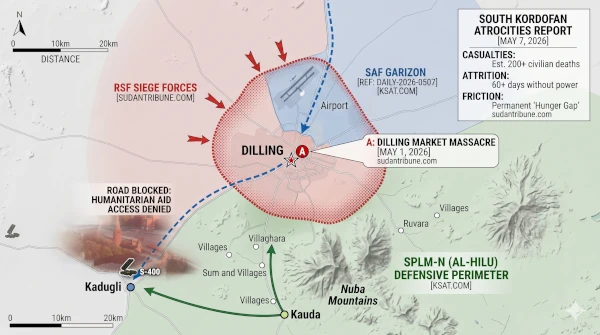
The city of Dilling and its surrounding areas in South Kordofan have become the epicenter of a horrific intersection of the Sudanese Armed Forces (SAF), the Rapid Support Forces (RSF), and the Sudan People’s Liberation Movement-North (SPLM-N) sudantribune.com.

I. The Tactical Friction: A Three-Way Siege

Dilling is strategically vital as a gateway between the Nuba Mountains and the plains of North Kordofan.

  • The “Zero-Sum” Front: The RSF has maintained a brutal siege on the city for months, while the SPLM-N (Al-Hilu faction) has moved in to “protect” Nuba populations, effectively turning the city into a fragmented battleground where civilians are trapped between three different command structures sudantribune.com.
  • Ethnic Targeting: Unlike the broader war in Khartoum, the violence in South Kordofan has taken on a strictly ethnic dimension. Reports indicate that Nuba and non-Arab communities are being systematically targeted for execution and displacement sudantribune.com.

II. The Humanitarian Friction: Systematic Erasure

The humanitarian fallout is no longer an accidental byproduct of war; it is being used as a weapon of coercion.

  • Conflict-Related Sexual Violence (CRSV): A joint statement from Canada, France, Germany, the UK, and the USA highlighted “appalling reports” of widespread sexual violence used by armed actors to terrorize the local population sudantribune.com.
  • The “Hunger Gap”: As of May 2026, the blockade of Dilling has prevented the planting of essential crops. UN observers warn that the “Hunger Gap” in South Kordofan is now permanent, with 85% of the population facing acute food insecurity sudantribune.com.

III. The “Global Silence” Factor

The crisis in South Kordofan represents a “High Friction” event that is largely invisible to global media.

  • Information Blackout: Telecommunications in Dilling have been cut for over 60 days. Most reports of massacres are only emerging weeks later via refugees reaching the South Sudanese border sudantribune.com.
  • Diplomatic Impotence: While the “Quad” (US, UK, Saudi, UAE) continues to negotiate for peace in Jeddah, the specific regional dynamics of the Nuba Mountains are being ignored, allowing local commanders to operate with perceived total impunity sudantribune.com.

WarsWW Intelligence Note [REF: SUDAN-SK-2026]

South Kordofan is the “High Friction” laboratory for 2026. It proves that when global attention is divided between the Middle East and Ukraine, regional actors in Africa will accelerate ethnic cleansing as a means of territorial consolidation. The Dilling Siege is not just a battle for a city; it is a battle for the ethnic survival of the Nuba people.
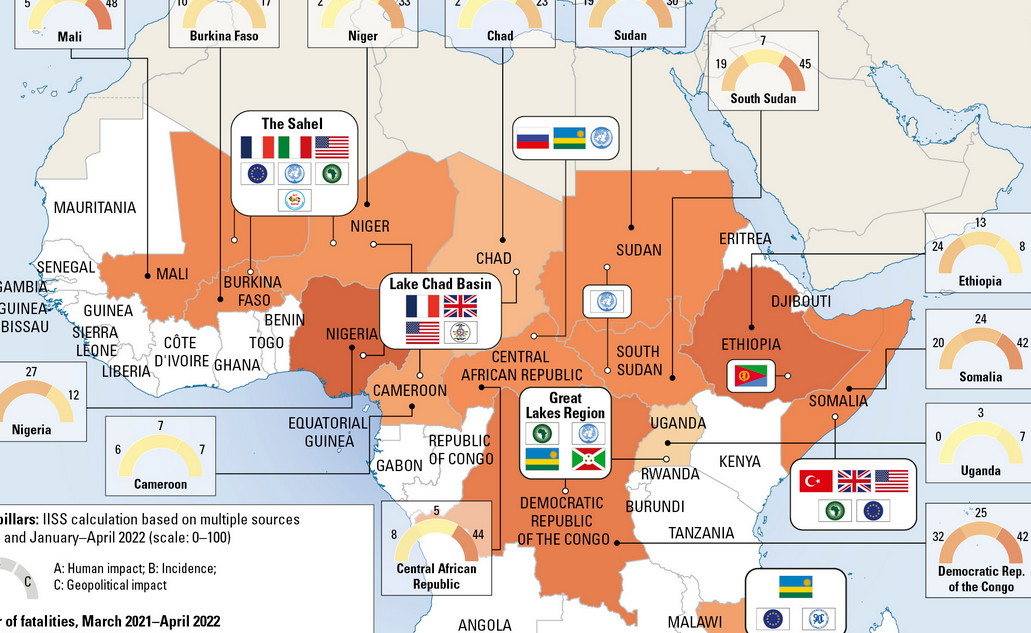
AES Response: The Liptako-Gourma Alliance Under Fire

Intelligence Status: REGIONAL PACT ACTIVATION / STRATEGIC DEFIANCE

Date: April 27, 2026

The Alliance of Sahel States (AES)—comprising the military-led governments of Mali, Niger, and Burkina Faso—has issued a defiant collective response following the devastating April 25 assassination of Malian Defense Minister Col. Sadio Camara [[4.2]]. In a joint communiqué released this morning, the alliance denounced the coordinated strikes as a “monstrous plot backed by the enemies of the liberation of the Sahel,” signaling a doubling down on their pivot away from Western security frameworks [[3.3]].

I. Full Mutual Solidarity: The Traoré Mandate

The current chair of the AES, President Ibrahim Traoré of Burkina Faso, emphasized the alliance’s “full, unconditional, and fraternal solidarity” with Bamako, characterizing the attacks as a foreign-coordinated attempt to derail the region’s course toward sovereignty [[3.3]]. Traoré asserted that the vile and cowardly nature of the strikes—which targeted multiple cities including Bamako, Gao, and Kidal simultaneously—would not shake the will of the Sahelian people [[5.2]].

II. Strategic Fallout: The “Green Zone” Breach

The AES response includes heightened domestic security measures across all three member states to prevent a “contagion” of insurgent success.

WarsWW Intelligence Note [REF: AES-PACT-2026]

The AES is facing its first major existential test. While their rhetoric remains defiant, the loss of Kidal to FLA rebels—and the forced withdrawal of Russian Africa Corps convoys—proves that the Liptako-Gourma Charter’s promise of mutual security is currently under extreme duress [[2.2]].


The Sahel Collapse — Assassination in Mali and the Wagner Retreat

Conflict Spotlight: The Sahel Collapse — Assassination in Mali and the Wagner Retreat

Intelligence Status: CRITICAL SECURITY BREAKDOWN

Location: Bamako and Northern Mali

Date: April 27, 2026

Extended Wrap-up (April 27, 2026-morning FLASH!)

Final “Situation Sweep.” The latest reports from Courthouse News and Reuters confirm a “fragile calm” in Bamako this morning, but the missing status of General Assimi Goïta is the ticking clock for your next update.

Mali is spiraling into its most severe security crisis in years following a weekend of coordinated, multi-front assaults that have fundamentally exposed the limits of Russian military influence in West Africa [[1.1]]. The crisis was ignited by the successful assassination of Mali’s Defense Minister, followed by a wave of surprise attacks that overran multiple bases manned by the Malian Armed Forces (FAMa) and their Russian “Africa Corps” (formerly Wagner Group) partners [[1.1], [2.1]].


I. The Bamako Assassination: Decapitating the Junta

In a stunning breach of the capital’s Green Zone, Mali’s Defense Minister, Col. Sadio Camara, was assassinated in a targeted strike on Saturday [[1.1]]. Camara was regarded as the primary architect of the 2021 coup and the key broker of the deal that brought Russian mercenaries into the Sahel [[2.2]].

The assassination signals a sophisticated level of penetration by insurgent groups into the heart of Bamako. Information warfare began immediately; Russian state media quickly framed the killing as “Western-backed terrorist activity,” a predictable narrative designed to justify a continued, and perhaps expanded, Wagner/Russian presence [[1.1]].

II. The Northern Wave: Russian Limits Exposed

Simultaneously, a wave of “coordinated, surprise attacks” struck military outposts across the landlocked desert nation. The onslaught was led by an unusual strategic realignment: jihadist militants and a separate alliance of Tuareg separatist groups launching concurrent offensives [[2.1]].

II. The Broad Sahel Fallout

The Malian breakdown is triggering a cascade of security failures across the broader region [[3.1]]:


Conflict Spotlight: The Sahel Collapse — Assassination in Mali and the Wagner Retreat

Intelligence Status: CRITICAL SECURITY BREAKDOWN

Location: Bamako and Northern Mali

Date: April 27, 2026

Mali is spiraling into its most severe security crisis in years following a weekend of coordinated, multi-front assaults that have fundamentally exposed the limits of Russian military influence in West Africa [[1.1]]. The crisis was ignited by the successful assassination of Mali’s Defense Minister, followed by a wave of surprise attacks that overran multiple bases manned by the Malian Armed Forces (FAMa) and their Russian “Africa Corps” (formerly Wagner Group) partners [[1.1], [2.1]].

I. The Bamako Assassination: Decapitating the Junta

In a stunning breach of the capital’s Green Zone, Mali’s Defense Minister, Col. Sadio Camara, was assassinated in a targeted strike on Saturday [[1.1]]. Camara was regarded as the primary architect of the 2021 coup and the key broker of the deal that brought Russian mercenaries into the Sahel [[2.2]].

The assassination signals a sophisticated level of penetration by insurgent groups into the heart of Bamako. Information warfare began immediately; Russian state media quickly framed the killing as “Western-backed terrorist activity,” a predictable narrative designed to justify a continued, and perhaps expanded, Wagner/Russian presence [[1.1]].

II. The Northern Wave: Russian Limits Exposed

Simultaneously, a wave of “coordinated, surprise attacks” struck military outposts across the landlocked desert nation. The onslaught was led by an unusual strategic realignment: jihadist militants and a separate alliance of Tuareg separatist groups launching concurrent offensives [[2.1]].

III. The Broad Sahel Fallout

The Malian breakdown is triggering a cascade of security failures across the broader region [[3.1]]:


WarsWW Intelligence Note [REF: SAHEL-COLLAPSE-2026]

The assassination of Camara and the rout of Russian forces prove that Moscow has overextended its hand in the Sahel [[1.1], [2.1]]. Its “state-capture” strategy—trading security for mineral access—relied on the facade of invincibility. That facade has now collapsed. Insurgents have proved that with minimal resources and advanced drone reconnaissance, they can dismantle a major Russian strategic investment [[1.2], [3.2]].


Source Registry: Sahel Crisis [REF: MALI-2026-0427]

Ref ID Primary Source Report Summary
[[1.1]] France24 / AFP (Apr 27, 2026) Breaking news of Defense Minister Sadio Camara’s assassination in Bamako.
[[1.2]] The National (Apr 27, 2026) Details on the “Kidal Rout” and the failure of the Wagner “security umbrella.”
[[2.1]] Associated Press / PBS (Apr 26, 2026) Background on the 2,000 Russian troops and the coordinated “Tuareg” surprise attacks.
[[3.1]] VOA News (Apr 27, 2026) Reports on Niger spillover violence and the FAMa border casualties.
[[3.3]] Human Rights Watch (Apr 25, 2026) Accusations of the Burkina Faso army executing 223 civilians.


Wagner Group Security Umbrella “Meltdown”

The Wagner Group’s “security umbrella” in the Sahel—specifically in Mali—has experienced a “meltdown,” failing to provide stability and instead aggravating conflict, according to a 2025 investigative report. While initially invited to replace French forces and reverse jihadist gains, Wagner’s tactics have failed to secure key regions, resulting in high casualty rates for both local soldiers and Russian mercenaries, and an increase in violence against civilians. 

Key Aspects of the Wagner “Security Umbrella” Failure

Why the “Security Umbrella” Failed
The failure is largely attributed to an over-reliance on brute force rather than comprehensive, population-centric counterinsurgency strategies. Wagner failed to manage the “local” aspect of the conflict, leading to intelligence deficits, and relied on poor coordination with local army forces (FAMa). As a result, the “security umbrella” became a “meltdown” that deepened, rather than solved, the security crisis in Mali and the wider Sahel. 


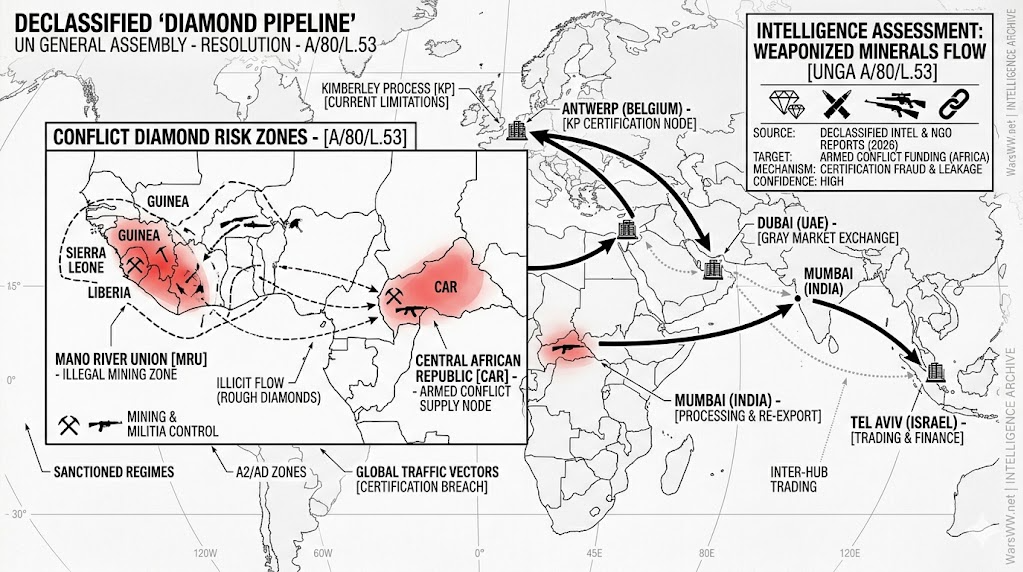
UN General Assembly Adopts Key Resolution to Sever Link Between Diamond Trade and Armed Conflict

April 17, 2026: The “Illicit Flow” Breakdown

On Wednesday, April 15, the UN General Assembly (UNGA) adopted resolution A/80/L.53, formally titled “The role of diamonds in fuelling conflict: breaking the link between the illicit transaction of rough diamonds and armed conflict.” This move underscores a growing international frustration with the limitations of the current Kimberley Process (KP).

The Intelligence Core: Why This Resolution Matters Now

While the resolution was adopted without a vote, the debate revealed deep geopolitical fissures that will affect conflict zones in 2026:


The Intelligence Brief: On April 15, the UN General Assembly adopted resolution A/80/L.53, but the session was defined by a growing rift over the definition of “conflict diamonds.”

This resolution (A/80/L.53) highlights that “Conflict Diamonds” are no longer just a rebel militia issue, but a primary funding vector for sanctioned states. For deeper context on how this impacts current theater funding, see our [Syria Spotlight].


Follow up to this article:


Nigeria Airstrike Accountability: The Yobe State Marketplace Massacre

On April 11, 2026, a Nigerian Air Force (NAF) strike decimated the Jilli weekly market in Yobe State, near the border with Borno State. This incident has triggered a wave of international condemnation and renewed calls for accountability regarding the NAF’s history of “misfires” in civilian areas.

Verification of Casualties

Internet and Communications Suppression

Monitoring of Nigerian digital infrastructure in early 2026 reveals a complex landscape of outages. While the government has historically used shutdowns to curb unrest, current data suggests a mix of systemic fragility and potential conflict-related disruption:


Origin of the Uprising

The strike occurred in the heartland of an insurgency that has ravaged Northeast Nigeria for nearly two decades. Understanding the current violence requires looking back at its 2009 inception:

  1. Founding (2002): Mohammed Yusuf founded Boko Haram (formally Jama’atu Ahlis Sunna Lidda’awati wal-Jihad) in Maiduguri, opposing Western education and seeking an Islamic state.
  2. The 2009 Uprising: The conflict turned bloody in July 2009 after a crackdown on the group led to a full-scale armed rebellion across Bauchi, Borno, and Yobe states.
  3. Escalation: Following Yusuf’s death in police custody, Abubakar Shekau took control, shifting the group toward extreme brutality.
  4. The Split: In 2016, the group fractured, leading to the rise of ISWAP (Islamic State West Africa Province). Both groups now compete for control in Yobe, often embedding themselves near civilian centers like the Jilli market, which the military uses as justification for high-risk strikes.

International Scrutiny and Response

The UN and African Union (AU) are facing immense pressure to move beyond “grave concern.”


Verified Sources for Casualty Data

Summary of Discrepancies

You may wish to note the discrepancy in public news reporting:


BAIDOA, SOMALIA: Federal Government of Somalia (FGS) has assumed full control of Baidoa

The strategic takeover of Baidoa by federal forces marks a critical junction in the ongoing decentralization crisis in Somalia. This event, occurring on March 30, 2026, has reshaped the political map of the South West State and significantly impacted the humanitarian landscape.

Federal Forces Seize Baidoa: End of Stand-off with South West State Authorities

BAIDOA, SOMALIA (March 31, 2026) — In a decisive military and political move, the Federal Government of Somalia (FGS) has assumed full control of Baidoa, the interim capital of the South West State (SWS). The takeover follows two weeks of escalating tensions that brought the city to the brink of large-scale urban warfare and triggered a mass displacement of civilians.

The Military Escalation

The confrontation reached a breaking point on March 30, when an FGS military convoy, reportedly consisting of 600 to 800 soldiers supported by local allied militias, entered the city.

Root of the Conflict: The Constitutional Dispute

The epicenter of the dispute lies in a fundamental disagreement over governance and term limits:

Humanitarian Crisis & Displacement

The political brinkmanship has exacted a heavy toll on the local population. According to reports from DG ECHO and the UN, the insecurity led to:

Expert Analysis: The “Domino Effect”

Analysts at the Horn Review suggest this takeover is a major victory for President Hassan Sheikh Mohamud’s administration but warns of a “domino effect.” With SWS now under federal alignment, the FGS has secured a key power base holding 78 seats in the federal parliament. However, the move has further alienated Puntland and Jubaland, who view the use of military force in Baidoa as a dangerous precedent that threatens the very fabric of Somalia’s federal system.

This report is based on verified data from AFP, ReliefWeb, and the European Commission.

As an independent outlet, we prioritize the humanitarian impact alongside military movements. The peaceful entry into the city center avoided a “bloodshed” scenario, but the political fallout for the 2026 national elections remains the critical story to watch.


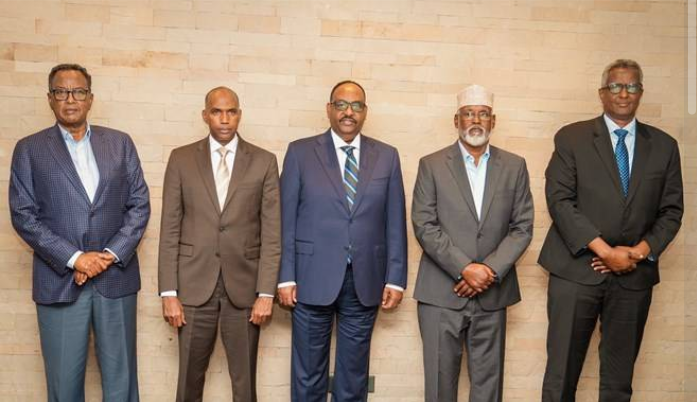
The Somali Future Council (SFC) is a major political opposition coalition formed in October 2025 by regional state leaders and prominent national opposition figures, primarily aimed at challenging the Federal Government of Somalia (FGS) regarding constitutional reforms and election procedures.

Key details regarding the Somali Future Council as of early 2026:

The coalition is regarded as the largest opposition group facing President Hassan Sheikh Mohamud as the country approaches the end of the current government’s term in May 2026.

Photo from: https://hiiraan.com

Africa Internet Outages Worsen Crises

Amidst rising regional tensions and environmental crises, the Horn of Africa and neighboring regions are currently grappling with significant digital disruptions. Recent reports from late March 2026 indicate that Zimbabwe and Ethiopia have been hit by critical Border Gateway Protocol (BGP)-level internet outages, lasting upwards of 24 hours, while Chad has also exhibited unusual connectivity anomalies network outage report 2026.

Humanitarian Crisis Compounded by Connectivity Gaps

The timing of these disruptions is particularly devastating for Ethiopia, which is already reeling from a series of natural disasters. On March 10, 2026, torrential rains in the Gamo Zone of Southern Ethiopia triggered massive flooding and landslides. At least 125 people have been confirmed dead, and over 11,000 residents have been affected, many of whom are now displaced and seeking shelter in churches and schools humanitarian crisis report.

The BGP-level outages—which effectively “unpublish” a country’s network from the global internet map—have severely hindered relief efforts. Humanitarian organizations such as the Ethiopian Red Cross and the World Food Program rely on digital coordination to navigate blocked roads and deliver medical supplies to remote highland areas disaster update March 16. Without stable internet, the ability to issue early warnings for continued rainfall or to coordinate life-saving trauma care has been crippled.

Who is Behind the Outages?

While some global outages in early 2026 have been attributed to technical misconfigurations—such as a major Cloudflare BGP error in February—the disruptions in Ethiopia and Zimbabwe are frequently tied to state actors.

Impact on Regional Conflicts

Digital blackouts are increasingly being “weaponized” to manage ongoing conflicts in the region:

  1. Accountability Vacuum: In areas like Oromia and the northern regions, shutdowns prevent journalists and international observers from documenting human rights abuses, including extrajudicial killings and sexual violence Amnesty Ethiopia report.
  2. Military Advantage: By severing communications, state forces can conduct operations without the risk of real-time civilian reporting or opposition coordination. Research has shown a direct correlation between the duration of internet blackouts and the number of conflict-related deaths in specific regions.
  3. Economic Sabotage: These outages have massive economic costs, with sub-Saharan Africa losing over $1.6 billion in 2024 due to shutdowns. In 2026, these disruptions continue to stifle online remittance systems and banking, further destabilizing populations already vulnerable to food insecurity and inflation.

As the UN and organizations like UNESCO warn of the rising trend of digital blackouts, the current situation in East and Southern Africa serves as a stark reminder of how infrastructure can be used to isolate populations during their most critical moments of need.

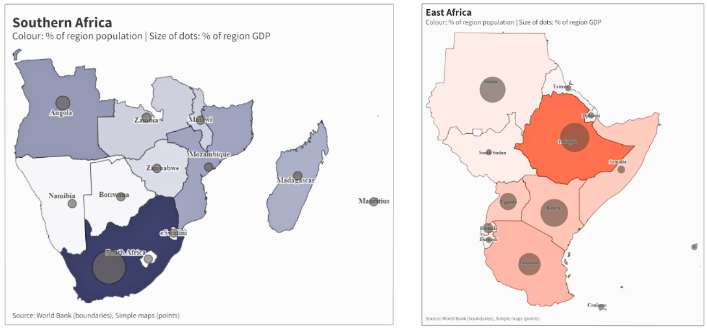
Image from https://issafrica.org