PGSA Strait Of Hormuz Permit Toll | Refinery Drone Strike May 21 2026
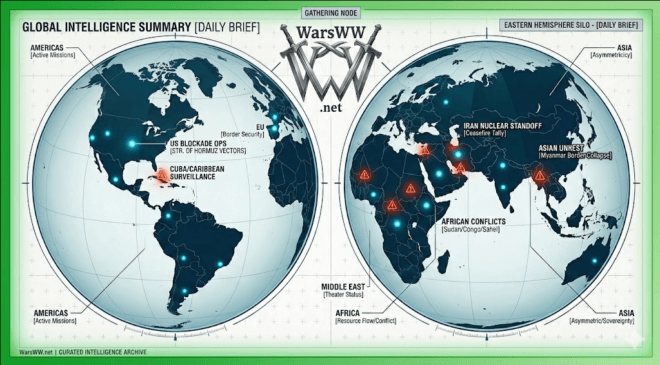
WarsWW Daily Brief | May 21, 2026
Intelligence Status: SOVEREIGN WATERWAY ENFORCEMENT / PETROLEUM INTERDICTION
Global Security Index: 9.8/10 (Severe Market Friction)
IRAN CHARTS PGSA BOUNDARIES IN HORMUZ TO ENFORCE PERMIT MANDATE; UKRAINIAN DRONES STRIKE SYZRAN REFINERY 800KM DEEP; US NAVY SEIZES TANKER IN GULF OF OMAN.
I. Middle East: Iran Institutionalizes the Hormuz “Permit & Toll” Regime
The standoff in the West Asia conflict has advanced from tactical military skirmishes to an aggressive legal and bureaucratic annex of global trade. Following weeks of maritime disruptions since the outbreak of hostilities in February, Tehran has operationalized a new mechanism to permanently sovereignize international transit passage through the Strait of Hormuz.
- The PGSA Electronic Net: The newly minted Persian Gulf Strait Authority (PGSA) has officially drawn its geographic boundaries of enforcement. The zone functions as a strict maritime checkpoint bounded by a line connecting Kuh-e Mobarak (Iran) to southern Fujairah (UAE) on the eastern side, stretching to the tip of Qeshm Island (Iran) and Umm Al-Quwain (UAE) on the western threshold.
- The Permit Mandate: All commercial shipping intending to cross the chokepoint must now coordinate directly with and secure digital authorization from the PGSA before tracking into the strait. Maritime intelligence firms note this effectively converts a historically open transit corridor into a state-administered permit and toll regime.
- Kinetic Enforcement: The Islamic Revolutionary Guard Corps (IRGC) Navy is actively backing this regulatory push from Qeshm Island. The IRGC reiterated that warships are completely barred from passage and defended prior kinetic targeting of non-compliant vessels, asserting that refusal to obtain permits violates sovereign governance.
- The US Counter-Blockade: The Trump administration is pushing back aggressively to force the waterway open. The US military boarded an Iranian-flagged oil tanker in the Gulf of Oman suspected of violating the American naval blockade. Simultaneously, Pakistan’s Army Chief Asim Munir has arrived in Tehran to mediate high-stakes peace proposals as Trump warns that negotiations are sitting on the borderline between a structural breakthrough and renewed military action.
II. Eastern Europe: The Syzran Refinery Strike
Ukraine’s strategic air campaign against the Russian energy ecosystem reached deeper into the domestic rear overnight, executing a highly accurate long-range drone operation.
- The 800-Kilometer Incursion: Ukrainian long-range kamikaze drones bypassed extensive electronic warfare frameworks to target the Syzran Oil Refinery in the southern Samara region, more than 800 kilometers (500 miles) deep inside Russian territory.
- Operational Impact: President Volodymyr Zelenskyy confirmed the attack, which ignited major fires across the Rosneft-operated facility. Local authorities acknowledged that two people were killed in Syzran during the raid. The strike severely degrades Russia’s capacity to process crude into military-grade fuel, following previous drone actions that have forced multiple central refineries to cut or entirely halt production.
- The Air Attrition War: Russia’s Defense Ministry claimed its defensive grids intercepted a staggering 121 Ukrainian drones across the country. Conversely, Moscow launched its own wave of 116 drones into Ukrainian civilian and energy hubs, with Ukraine’s tactical air defense systems successfully downing 109 of the incoming targets.
III. Indicators to Watch
- [LOGISTICS] Tanker Compliance Matrix: Watch the insurance telemetry of global shipping conglomerates over the next 48 hours. If European or Asian tankers begin complying with the email-based PGSA permit mandates, it will signal a de facto recognition of Iran’s regulatory control over the chokepoint.
- [DIPLOMACY] The Enriched Uranium Redline: Monitor the outcome of Pakistan’s mediation track in Tehran. Hardline factions within Iran are pushing to keep highly enriched uranium inside the country, directly defying a core American prerequisite for lifting the naval blockade.
WarsWW Intelligence Note [REF: DAILY-2026-0521]
The creation of the PGSA is a masterclass in asymmetrical lawfare. By utilizing a nominal regulatory entity to dictate maritime coordinates between Iran and the UAE, Tehran is attempting to force commercial fleets to pay for protection, turning an active combat zone into a bureaucratic customs barrier. Meanwhile, Ukraine’s successful penetration into Samara proves that Russia’s massive electronic warfare investment cannot perfectly insulate its economic lifeblood from persistent, low-RCS drone swarms.